Screening for HPV and/or HPV-related cancers is currently only available for cervical cancer or cervical/vaginal infection
Screening Tests
There are two types of screening tests:
- HPV test: this test looks for HPV infection
- Cervical cytology “Pap” test (or Pap smear): this test looks for precancerous changes in cells on the cervix that may become cancer if untreated
In some circumstances co-testing may occur, this combines both the HPV and cervical cytology “Pap” test.
Current Screening Recommendations
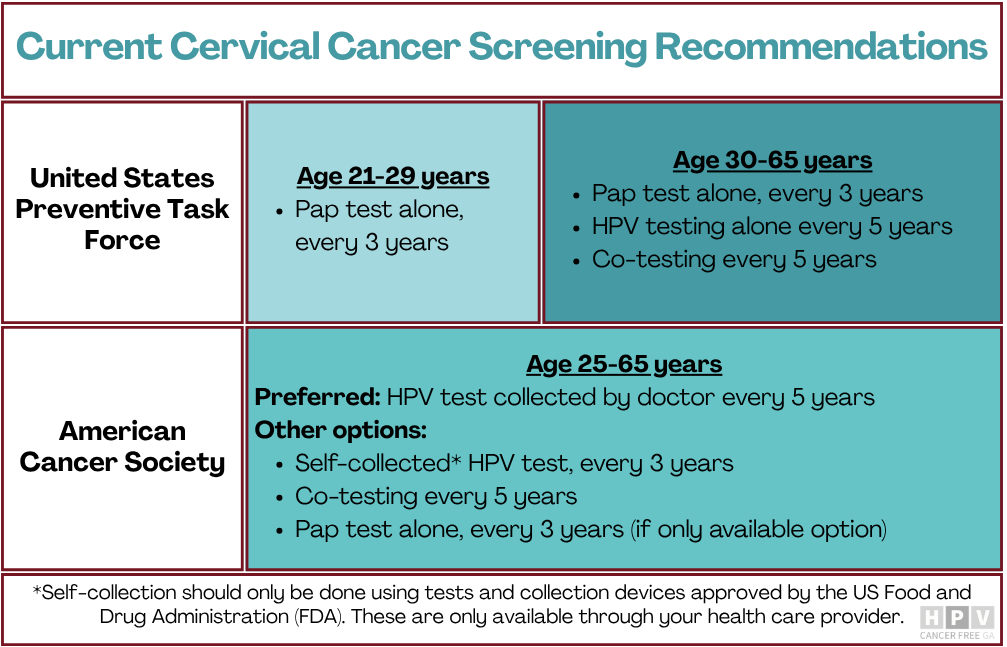
For more detailed recommendations, please refer to the following resources:
- United States Preventive Task Force Cervical Cancer Screening Recommendations 2018
- The USPTF was last updated in 2018 and is currently under review.
- American Cancer Society Cervical Cancer Screening Recommendations
You MAY NOT need to be screened anymore if:
- You have had a hysterectomy with removal of the cervix, and do not have a history of cervical cancer (including pre-cancer)
- You are 65 years or older and:
- You have had at least 3 Pap tests or 2 HPV test in the past 10 years, and the results were normal/negative
AND
-
- Are not considered at high-risk for cervical cancer
You should speak with your doctor to determine if cervical cancer screening is recommended for you!
Self-Collection HPV Testing
Self-collection is now available as an option for screening, and can be done privately at a clinic or in your own home. Self-collection should only be done using tests and collection devices approved by the US Food and Drug Administration (FDA). For more information contact your health care provider to see if self-collection HPV testing is an option for you.
HPV tests that you can order online yourself are not recommended and may not be accurate.
Please vist the American Cancer Society to learn more about self-collection HPV testing.
Find Screening
Contact your primary care provider or OB/Gyn to schedule an appointment. Pap and HPV testing are usually done at the same time as a pelvic exam and covered by most insurance. Medicare Part B (medical insurance) covers routine Pap and HPV tests, once every 24 months in most cases. Be sure to determine with your doctor what Medicare will actually cover.
For individuals who are low-income, underinsured, or un-insured, you may be eligible for free or low-cost screening services through the CDC’s National Breast and Cervical Cancer Early Detection Program (NBCCEDP). You may be eligible for free or low-cost cervical cancer screening if:
- You have no insurance, or your insurance does not cover screening exams
- Your yearly income is at or below 250% of the federal poverty level
- You are 21 to 64 years of age (certain women who are younger or older may qualify for screening services)
If you are in the state of Georgia, please visit the Georgia Department of Public Health’s Breast and Cervical Cancer Program to see if you qualify for services at no or low cost. If you are located outside of Georgia, please visit the CDC NBCCEDP's page to find services near you.